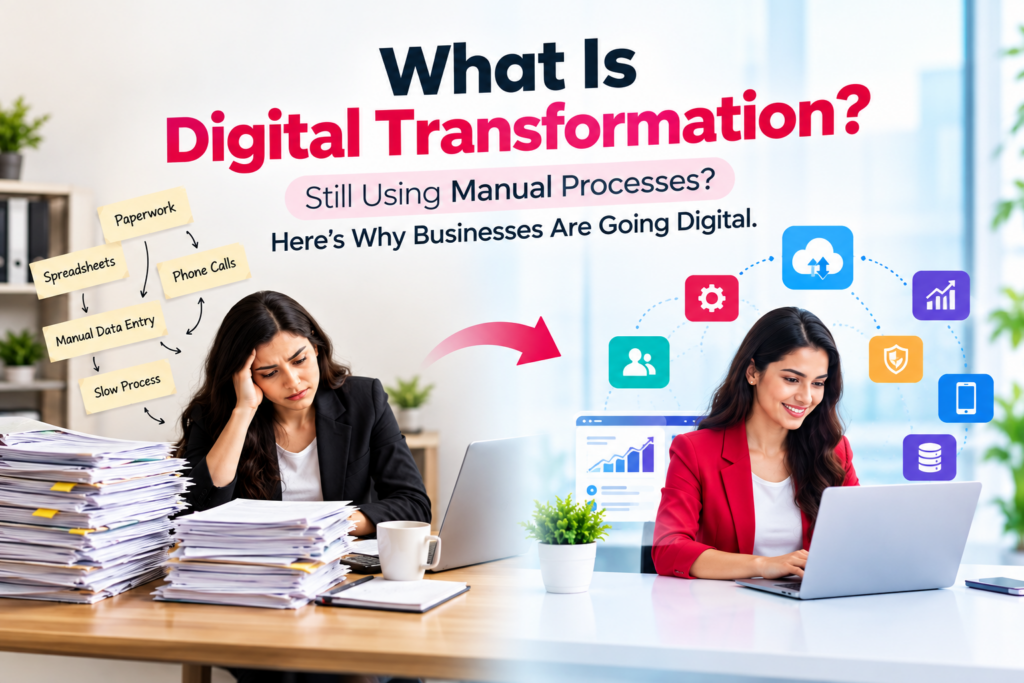
Many businesses still depend on spreadsheets, paperwork, phone calls, manual data entry, and disconnected tools to manage their daily operations. These methods may work when a business is small, but as the business grows, manual processes can become slow, expensive, and difficult to manage.
This is where digital transformation comes in.
Digital transformation is not simply about buying new software or moving from paper to computers. It is about using technology, automation, data, and digital systems to improve the way a business operates, serves customers, and makes decisions.
For businesses looking to grow efficiently, digital transformation is becoming less of an option and more of an important part of long-term business strategy.
What Is Digital Transformation?
Digital transformation is the process of using modern digital technologies to improve business processes, customer experiences, employee productivity, and overall operations.
It can involve technologies such as:
- Custom business software
- Cloud-based applications
- Mobile applications
- Artificial intelligence
- Business automation
- Data analytics
- Customer relationship management (CRM)
- Enterprise resource planning (ERP)
- Digital payment systems
- Online communication and collaboration tools
- API integrations
For example, instead of maintaining customer information in physical files or multiple Excel sheets, a business can use a centralized software system where customer data, orders, payments, communication, and history are managed in one place.
That’s digital transformation in practice.
Why Are Businesses Moving Away From Manual Processes?
Manual processes often appear simple because they don’t require significant technology investment at the beginning. However, they can create hidden costs as the business grows.
1. Manual Work Takes More Time
Consider a business where employees manually enter customer information, prepare invoices, update spreadsheets, send follow-up messages, and create reports.
Each task may take only a few minutes.
But when hundreds or thousands of transactions are involved, those minutes become hours.
Automation can handle repetitive tasks much faster, allowing employees to focus on activities that actually require human decision-making.
2. Human Errors Can Affect Business Operations
Manual data entry increases the possibility of mistakes.
A wrong number in a spreadsheet, duplicate customer record, incorrect invoice, or missed update can create problems across different departments.
Digital systems can reduce these errors by:
- Validating information
- Automating calculations
- Using predefined workflows
- Maintaining centralized records
- Reducing duplicate data entry
Automation doesn’t eliminate every business error, but it can significantly reduce errors caused by repetitive manual work.
3. Business Data Becomes Difficult to Manage
When information is stored across notebooks, Excel files, emails, WhatsApp messages, and separate applications, finding the right information can become difficult.
A digital system can bring important information together.
For example, a custom business application could provide access to:
Customers → Orders → Payments → Employees → Inventory → Reports
from a centralized platform.
This makes information easier to access and manage.
Digital Transformation Improves Business Productivity
One of the biggest advantages of digital transformation is improved productivity.
Instead of employees spending their working hours on repetitive administrative tasks, automated systems can handle many routine activities.
For example:
Traditional Process
Customer enquiry → Employee records details → Employee checks availability → Calls customer → Creates booking → Updates spreadsheet
Digital Process
Customer enquiry → Online form → Automated availability check → Booking confirmation → Database update
The second process requires fewer manual steps and provides a more consistent experience.
Automation Is a Major Part of Digital Transformation
Automation is one of the most useful components of digital transformation.
Businesses can automate processes such as:
- Invoice generation
- Email notifications
- Customer follow-ups
- Appointment reminders
- Employee attendance
- Order processing
- Inventory alerts
- Payment confirmations
- Report generation
- Lead assignment
- Data synchronization
For example, an eCommerce business can automatically update inventory after an order is placed.
Similarly, an HRMS can automatically calculate attendance, generate reports, and notify employees about important updates.
Better Customer Experience
Digital transformation isn’t only about improving internal operations.
It can also change how customers interact with a business.
Customers increasingly expect:
- Quick responses
- Online services
- Easy payments
- Real-time updates
- Mobile-friendly experiences
- Self-service options
- Faster support
For example, instead of asking customers to call a business to check an order status, a digital system can allow them to check the status online.
This reduces workload for employees while giving customers faster access to information.
Data Helps Businesses Make Better Decisions
Manual processes often make it difficult to understand what is happening across the business.
Digital systems can collect and organize operational data so businesses can analyze important metrics.
For example:
- Which products sell the most?
- Which services generate the most revenue?
- How many leads convert into customers?
- Which employees handle the most tasks?
- Where are customers dropping out of the sales process?
- How much inventory is available?
- Which expenses are increasing?
Instead of relying entirely on assumptions, businesses can use data to understand their operations.
Cloud Technology Makes Business Systems More Accessible
Cloud-based applications have also contributed significantly to digital transformation.
With a cloud-based system, authorized users can access business information through the internet without depending entirely on a single office computer or local server.
Depending on the system, businesses can provide access to:
- Employees
- Managers
- Customers
- Vendors
- Remote teams
- Administrators
This can be especially useful for businesses operating across multiple locations.
Digital Transformation Doesn’t Mean Replacing Everything
A common misconception is that digital transformation means completely replacing existing systems.
That’s not always necessary.
Businesses can start with the processes that create the biggest problems.
For example:
Step 1: Move paper records to a digital database.
Step 2: Automate repetitive tasks.
Step 3: Introduce online customer services.
Step 4: Connect different business systems through integrations.
Step 5: Use analytics and dashboards for decision-making.
Step 6: Continue improving processes based on business data.
This gradual approach can make digital transformation more practical and manageable.
What Businesses Can Digitize
Almost every department can benefit from digital systems.
Finance
- Invoicing
- Expense management
- Payment tracking
- Financial reporting
- Reconciliation
Human Resources
- Employee records
- Attendance
- Leave management
- Payroll processes
- Performance tracking
Sales & Marketing
- Lead management
- CRM
- Follow-ups
- Campaign tracking
- Customer communication
Operations
- Workflow management
- Task allocation
- Inventory
- Order processing
- Reporting
Customer Service
- Support tickets
- Customer history
- Automated notifications
- Feedback collection
- Self-service portals
Custom Software Can Support Digital Transformation
Every business operates differently.
Ready-made software can be useful, but it may not always match a company’s exact workflow.
This is where custom software development can help.
A custom business application can be designed around specific requirements, processes, users, and integrations.
For example, a company may need a system that combines:
CRM + Inventory + Billing + Employee Management + Reporting
into one platform.
Instead of forcing employees to work around the limitations of multiple applications, a custom solution can be designed around the organization’s actual workflow.
Is Digital Transformation Only for Large Companies?
No.
Small and medium-sized businesses can also benefit from digital transformation.
In fact, smaller businesses can begin with focused improvements such as:
- Online booking
- Digital payments
- CRM
- Cloud accounting
- Inventory software
- Employee management
- Customer portals
- Business dashboards
The goal isn’t to adopt every new technology.
The goal is to identify where technology can solve a real business problem.
Challenges Businesses Should Consider
Digital transformation also comes with challenges.
Businesses may need to consider:
Employee Training
Employees need time and training to understand new systems.
Data Security
Customer and business information must be protected through appropriate security controls.
Integration
New software may need to communicate with existing applications.
Initial Investment
Software development, implementation, migration, and training can require upfront investment.
Change Management
Employees may initially prefer familiar manual processes. Clear communication and training can help with adoption.
A successful transformation therefore requires more than technology. It requires planning, people, processes, and continuous improvement.
How to Start Your Digital Transformation Journey
If your business is still heavily dependent on manual processes, you don’t need to digitize everything at once.
Start by asking:
- Which process takes the most employee time?
- Where do errors happen frequently?
- Which information is difficult to find?
- Which tasks are repeated every day?
- Where do customers experience delays?
- Which departments use separate systems?
- What reports take too long to prepare?
Once these areas are identified, you can prioritize the processes where technology can create the greatest operational improvement.
Final Thoughts
Digital transformation is not simply about becoming a “digital business.”
It is about making business processes faster, more connected, measurable, and easier to manage.
If employees are spending hours on repetitive data entry, customers are waiting for basic information, or important business data is scattered across spreadsheets and paperwork, it may be time to rethink the way those processes work.
The right digital solution can help businesses automate routine work, centralize information, improve customer experiences, and create a stronger foundation for future growth.
Still using manual processes? The first step toward digital transformation may simply be identifying what is slowing your business down.Cloud & IT Solutions: The Complete Guide to Accelerating Business Growth in 2026How Custom Software Development Helps Businesses Grow in 2026