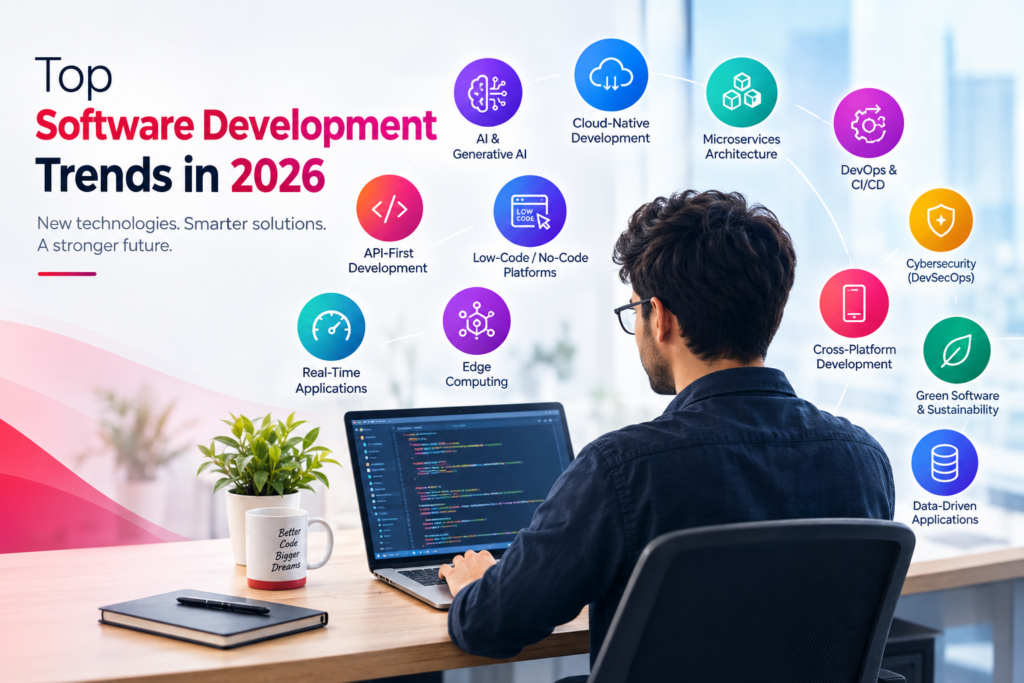
Software development is changing faster than ever. A few years ago, businesses mainly focused on having a website or a basic business application. Today, companies expect software to do much more—it should be fast, secure, scalable, intelligent, easy to use, and capable of adapting as the business grows.
The rise of artificial intelligence, cloud computing, automation, modern development frameworks, and connected systems is changing the way software is designed and built. Developers are no longer just writing code to create applications. They are building systems that can understand data, automate repetitive tasks, support business decisions, and provide better experiences to users.
For businesses planning a new software product or upgrading an existing system, keeping up with these changes is important. Choosing the right technology today can make a big difference in the software’s performance, maintenance, and scalability tomorrow.
So, what should businesses and developers pay attention to in 2026?
Let’s look at some of the major software development trends shaping the industry this year.
1. AI-Powered Software Development
Artificial intelligence has moved from being an experimental technology to becoming a practical part of software development.
In 2026, AI is being used across different stages of development—from writing and reviewing code to testing, debugging, documentation, and software maintenance.
AI-powered development tools can help developers identify errors, generate code suggestions, understand existing code, and automate repetitive development tasks. This doesn’t mean developers are becoming unnecessary. Instead, AI is becoming another tool that helps developers spend more time solving complex problems and less time on repetitive work.
Businesses are also integrating AI directly into their software products.
For example, a business application may include:
- AI-powered customer support
- Intelligent search
- Automated document processing
- Recommendation systems
- Predictive analytics
- Natural language interfaces
- Automated report generation
The important trend in 2026 is not simply “using AI.” It is finding practical ways to use AI where it actually improves a product or business process.
2. AI Agents and Autonomous Workflows
One of the biggest developments around AI is the growing use of AI agents.
Traditional software usually waits for a user to perform an action. An AI agent can understand a goal, process information, decide what steps are needed, and perform certain tasks with limited human intervention.
For example, instead of an employee manually checking incoming customer requests, categorizing them, updating a CRM, and notifying the relevant team, an AI-powered workflow could handle much of this process automatically.
AI agents can potentially support areas such as:
- Customer service
- Sales operations
- Data analysis
- IT support
- Business reporting
- Document processing
- Workflow automation
However, businesses need to think carefully about permissions, data privacy, human oversight, and error handling before allowing AI agents to perform important business operations.
3. Cloud-Native Application Development
Cloud computing continues to play a major role in modern software development.
Businesses increasingly want applications that can scale when demand increases without requiring major infrastructure changes. Cloud-native development helps developers build applications specifically for cloud environments rather than simply moving traditional software to the cloud.
Cloud-native applications commonly use technologies such as:
- Containers
- Microservices
- Kubernetes
- Serverless computing
- Cloud databases
- API-based architectures
- Automated deployment pipelines
For a growing business, this approach can make it easier to handle changing workloads and deploy new features.
The key idea is simple: software should be designed with scalability, flexibility, and reliability in mind from the beginning.
4. Growth of Microservices Architecture
Large applications can become difficult to maintain when everything is tightly connected.
Microservices architecture addresses this by breaking an application into smaller, independent services. Each service can focus on a particular business function.
For example, an eCommerce platform might have separate services for:
- User accounts
- Product management
- Orders
- Payments
- Inventory
- Notifications
- Delivery
This structure allows teams to develop and update individual components without necessarily changing the entire application.
Microservices aren’t automatically the right choice for every project, though. For smaller applications, a well-designed monolithic architecture can still be simpler and more practical.
The trend in 2026 is therefore not “everything must become microservices.” It is choosing an architecture that matches the project’s actual requirements.
5. API-First Development
Modern applications rarely work as isolated systems.
Web applications, mobile apps, payment systems, CRM platforms, ERP systems, analytics tools, and third-party services often need to communicate with one another.
That’s where APIs become important.
API-first development treats APIs as a core part of the application architecture rather than something added later.
A well-designed API can make it easier to:
- Connect mobile and web applications
- Integrate third-party services
- Share data between systems
- Build new applications using existing functionality
- Support future integrations
For businesses planning software that may eventually connect with multiple platforms, an API-first approach can provide valuable flexibility.
6. Low-Code and No-Code Development
Low-code and no-code platforms continue to gain attention in 2026.
These platforms allow users to create certain applications and workflows with minimal traditional coding. Instead of building everything from scratch, users can work with visual interfaces, pre-built components, templates, and automation tools.
They can be useful for:
- Internal business tools
- Simple workflow automation
- Forms and dashboards
- Basic customer portals
- Approval systems
- Prototypes
However, low-code doesn’t mean every software project should avoid professional development.
Complex applications involving advanced business logic, high scalability requirements, custom integrations, security requirements, or unique user experiences may still require custom software development.
7. Cybersecurity Is Becoming Part of Development
Security can no longer be treated as something that happens after an application is finished.
With increasing cyber threats and growing amounts of business data being stored online, security needs to be considered throughout the software development lifecycle.
This has increased the importance of approaches such as DevSecOps, where security is integrated into development and deployment processes.
Developers are paying more attention to:
- Secure authentication
- Role-based access
- Data encryption
- API security
- Vulnerability testing
- Secure coding practices
- Dependency management
- Continuous security monitoring
For businesses, security isn’t only about protecting technical systems. A security incident can also affect customer trust and business operations.
8. DevOps and Continuous Delivery
Software development doesn’t end when developers finish writing code.
Modern teams need reliable processes for testing, deploying, monitoring, and updating applications.
DevOps brings development and operations teams closer together and encourages automation throughout the software lifecycle.
Continuous Integration and Continuous Delivery (CI/CD) can help teams:
- Test changes automatically
- Detect problems earlier
- Deploy updates more frequently
- Reduce manual deployment work
- Improve development consistency
In 2026, faster development isn’t simply about writing code faster. It’s about creating a smoother process from development to production.
9. Cross-Platform App Development
Businesses increasingly want their applications to work across multiple devices without maintaining completely separate codebases for every platform.
Cross-platform technologies such as React Native and Flutter continue to make this approach practical for many types of applications.
A cross-platform approach can help businesses develop applications for:
- Android
- iOS
- Tablets
- Web platforms in some cases
The right choice still depends on the project’s requirements. Applications that require highly specialized native capabilities may benefit from native development, while many business applications can work effectively with cross-platform technologies.
10. Progressive Web Applications
Progressive Web Apps, commonly known as PWAs, continue to provide an interesting middle ground between websites and traditional mobile applications.
A PWA can provide features such as:
- Fast loading
- Responsive design
- Offline capabilities
- Installability
- Push notifications
- App-like user experiences
For businesses that want mobile-friendly functionality without immediately building separate native applications, PWAs can be worth considering.
11. Edge Computing
Cloud computing isn’t disappearing, but more processing is also moving closer to users and devices.
This is where edge computing becomes important.
Instead of sending every piece of data to a centralized cloud server, some processing can happen closer to where the data is generated.
This can be particularly useful for applications where speed and response time are important, such as:
- IoT systems
- Smart devices
- Industrial applications
- Real-time monitoring
- Connected vehicles
- Video processing
Reducing the distance between the user or device and the computing resource can help reduce latency in suitable use cases.
12. Real-Time Applications
Users increasingly expect information to update instantly.
Think about messaging applications, delivery tracking, financial dashboards, collaboration tools, customer support systems, and live monitoring platforms.
Real-time technologies allow applications to push updates to users without requiring them to repeatedly refresh a page.
Technologies such as WebSockets and real-time APIs can support these experiences.
For businesses, real-time functionality can improve visibility and make applications feel more responsive.
13. Data-Driven Applications
Data has become one of the most valuable resources for modern businesses.
But simply collecting data isn’t enough.
Businesses need software that can organize, analyze, and present information in a useful way.
Modern applications are increasingly incorporating:
- Business intelligence dashboards
- Predictive analytics
- Data visualization
- Automated reports
- Real-time analytics
- Machine learning models
This allows businesses to move from simply storing information to using it to make better operational decisions.
14. Headless Architecture
Headless architecture separates the backend functionality from the frontend presentation layer.
This approach is becoming increasingly popular in areas such as eCommerce and content management.
For example, the same backend can potentially provide content or product information to:
- A website
- A mobile application
- A digital kiosk
- A smart device
- Other digital channels
This provides greater flexibility when businesses want to deliver the same information across multiple platforms.
15. Green Software Development
Software has an environmental impact too.
Applications run on servers and data centers that consume energy. As businesses become more conscious of sustainability, developers are paying more attention to how efficiently software uses computing resources.
Green software development focuses on reducing unnecessary resource consumption.
This can involve:
- Optimizing code
- Reducing unnecessary database queries
- Improving application performance
- Efficient infrastructure usage
- Optimizing cloud resources
- Reducing unnecessary data processing
Better performance and better resource efficiency can often go hand in hand.
16. Modernization of Legacy Software
Many businesses still rely on older software systems that are critical to daily operations.
Replacing such systems completely can be expensive and disruptive. As a result, software modernization is becoming an important area of development.
Businesses may gradually modernize legacy systems through:
- API integration
- Database modernization
- Cloud migration
- UI modernization
- Modular architecture
- Replacing outdated components
- Connecting legacy systems with newer applications
The goal isn’t always to throw away an existing system. Sometimes, a gradual modernization strategy can be more practical.
17. Greater Focus on User Experience
Technical functionality alone doesn’t guarantee a successful application.
Users expect software to be simple, fast, intuitive, and accessible.
This means developers and designers are increasingly working together from the beginning of the project.
Modern software development is paying more attention to:
- Mobile-first experiences
- Simple navigation
- Accessibility
- Fast page loading
- Personalized experiences
- Clear interfaces
- Consistent design systems
A technically powerful application can still struggle if users find it confusing or difficult to use.
18. Personalized Software Experiences
Users increasingly expect applications to understand their needs.
Personalization can be achieved through user preferences, behavior analysis, recommendation systems, and AI-powered features.
For example, an application could show different content, recommendations, dashboards, or notifications based on how a particular user interacts with the system.
When implemented responsibly, personalization can make software more useful without making the experience complicated.
What These Trends Mean for Businesses
Technology trends are useful, but businesses shouldn’t adopt a technology simply because it is popular.
The right technology depends on the actual problem the software needs to solve.
For example, a small internal business application may not need a complex microservices architecture or AI agents. On the other hand, a large enterprise platform handling millions of transactions may require advanced cloud infrastructure, scalable architecture, strong security, and automated deployment.
Before selecting technologies, businesses should consider:
- What problem are we solving?
- Who will use the software?
- How many users are expected?
- What data will the application handle?
- Does it need third-party integrations?
- How important is scalability?
- What security requirements exist?
- What is the expected budget?
- How will the software be maintained?
- What features may be needed in the future?
This approach helps prevent businesses from choosing technology first and trying to fit their requirements around it.
The Future of Software Development
Software development in 2026 is moving toward a combination of AI, automation, cloud infrastructure, security, scalability, and better user experiences.
But one thing remains unchanged: technology should solve real problems.
AI can make software smarter. Cloud platforms can make it more scalable. Automation can make development and business processes faster. Modern architectures can make systems easier to maintain.
But the value comes from how these technologies are used.
For businesses planning a new application or improving an existing system, understanding these trends can help them make better technology decisions and prepare their software for future requirements.
The goal shouldn’t be to use every new technology available. The goal should be to build software that is useful, secure, scalable, maintainable, and ready to grow with the business.